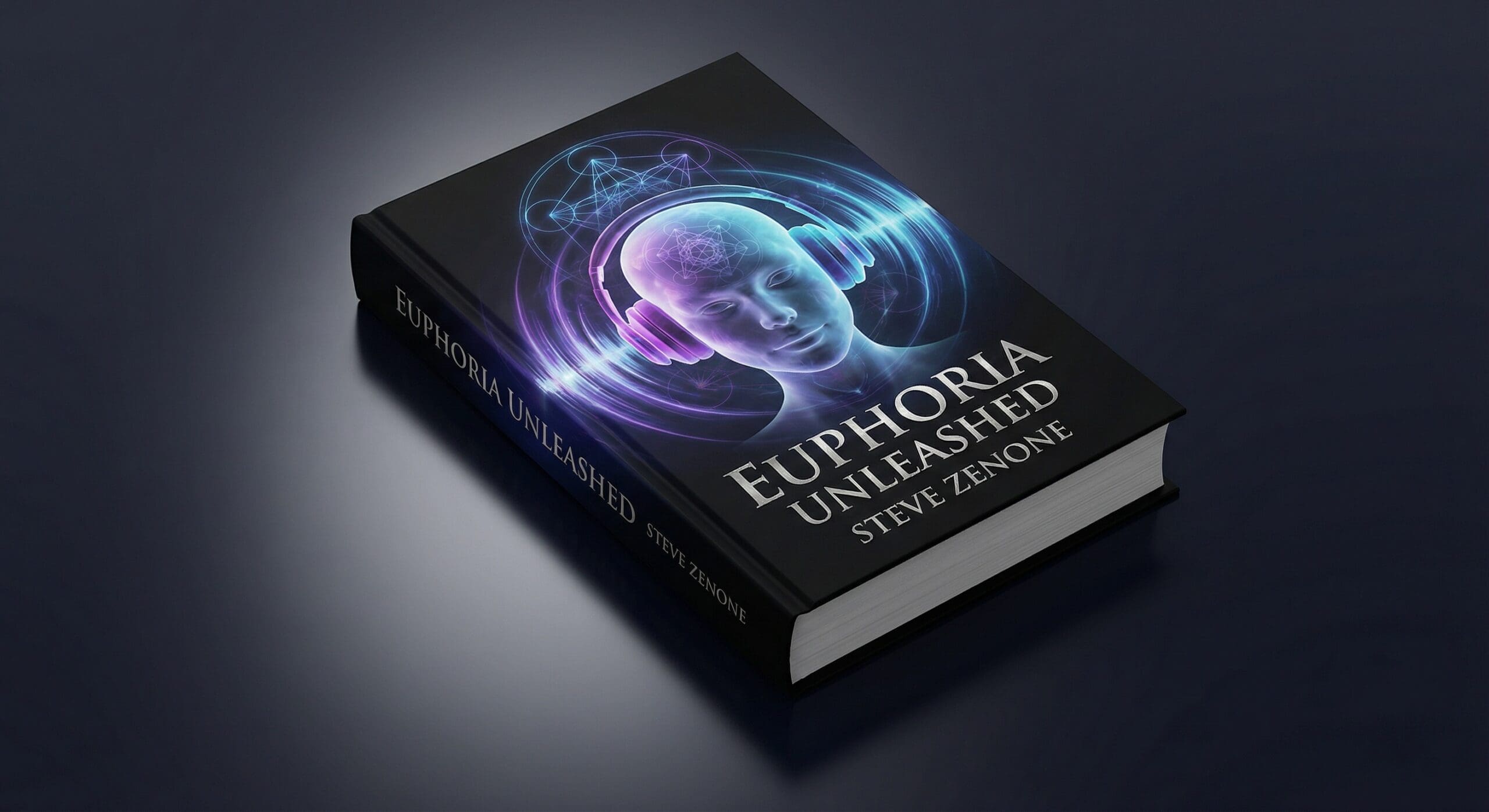
A book by Steve Zenone
Euphoria Unleashed
The Transformative Power of Trance Music
A history of trance. Where it came from, how it evolved and some of the science behind why it affects us the way it does.
Published .
There's a point in some trance tracks where something changes.
The build keeps adding pressure and holds it longer than feels comfortable. Then the track opens up and a room reacts almost as one, on the same beat, without anyone deciding to. I wanted to understand why that happens.
Where did this music come from? Which scenes carried it and who was actually building them? And why do repetition, held tension and a release you can hear coming still work on people who have heard it a thousand times? The book follows those questions through the history, the people and the research, and it says so when the research runs out.
The science
What research can explain, and where we're still connecting dots.
Rhythm and repetition are the best understood part. A steady pulse is easy to predict, and once you're predicting it you move with the track instead of after it. Anticipation is the next piece. Music that sets up an expectation and then delays it has been studied for years, and reward chemistry, dopamine included, comes up throughout that work.
After that it gets thinner. Time feels different on a dancefloor and plenty of people describe it the same way, but measuring that is hard. Moving in time with other people does seem to make them feel closer, though how much of that is the music and how much is the room and the hour is an open question. Altered states get talked about constantly in trance, and the honest version is that the scene used the word long before anyone tested it. There's no evidence that a particular BPM flips a switch in your head.
So the book stays with what holds up, marks the thin parts as thin and treats the rest as description rather than explanation. The page on how the tracks are built covers the mechanics you can hear for yourself.
How it evolved
Trance didn't appear fully formed.
It came out of early electronic records, new wave and industrial, then house and techno, and it took its own shape through European clubs and labels around the turn of the nineties. What followed was the golden age, the peak years, the progressive shift and whatever you want to call the current scene. Each of those changed the sound and the audience.
The timeline lays out all eight eras in order, and the companion playlist follows the same order in sound.
The people
Artists, in context.
Producers, DJs and label people turn up where they changed something: a production method, a night that pulled a scene together, a label that gave a sound somewhere to land or a record everyone after had to answer. The point is what they built and where they fit, not a ranking.
Where to start
You don't need to know the history to start here.
If you've been listening since the nineties, most of this fills in the parts around what you were already there for. If you found trance last year, start anywhere. The context is on the page when you want it, and the reference pages below are free.
What it is
What is Euphoria Unleashed?
It's a book about Trance music by Steve Zenone, out 26 March 2026. It works through the subgenres, the labels and the regional scenes to where the floor sits today, and it spends as much time on the culture around the music as on the records themselves.
If you want the detail, the chapters of the book are broken down chapter by chapter, the chronological companion playlist follows the same chronology in sound, and Steve's background in the scene explains where the book came from. The free reference pages sit alongside it: a history of trance music from the early electronic records to the current scene, a guide to the subgenres and what separates them, a trance history timeline covering the eight eras end to end, a trance glossary for the vocabulary, and research notes on how claims get sourced before they make it into print.
Inside the Book
Five ways in.
- 01
The Roots
Early electronic music, new wave and industrial, then house and techno. Where repetition became a method and the clubs, labels and record shops got built.
- 02
The History
The European emergence of Trance, the global expansion and the way the subgenres split apart, through to the current state of the genre.
- 03
The Craft
Technology, production and DJ culture. What the machines made possible, how the records were made and what it takes to hold a room for hours.
- 04
The Industry
Label profiles, regional scenes, the business of Trance and Trance in media. The people who built and ran the thing the music needed.
- 05
The Experience
The breakdown, the drop and the strange arithmetic of time on a dancefloor at four in the morning.
The chronology
Eight eras, in order.
The book follows this line, and so does the companion playlist. Start anywhere, but the order is deliberate.
Pre-Trance Roots
Kraftwerk, Tangerine Dream, Jean-Michel Jarre, Giorgio Moroder
EBM / Industrial Bridge
Front 242, Skinny Puppy, Nitzer Ebb
- 1989 - 1993
Birth of Trance
Orbital, The Orb, KLF, Future Sound of London, Jam & Spoon
- 1994 - 1999
Golden Age
Paul van Dyk, Robert Miles, Café Del Mar, Gouryella, Cygnus X
- 2000 - 2004
Peak Era
Tiësto, Chicane, Above & Beyond, BT, Rank 1
- 2005 - 2009
Progressive Shift
Gareth Emery, Dash Berlin, Aly & Fila, Markus Schulz
- 2010 - 2014
Modern Trance
Above & Beyond (Group Therapy era), Armin van Buuren (Intense era)
- 2015 - present
Contemporary
Vini Vici, Factor B, Gareth Emery, Armin van Buuren, Andrew Bayer
Free reference
A reference library for the genre.
Everything below is free to read and built from the same research as the book. Start wherever the question is.
What is Trance music?
The direct answer. The pulse, the repetition, the breakdown, rough tempo tendencies and how it differs from house and techno.
A history of Trance
From early electronic music to the contemporary scene, with the disputed parts marked as disputed.
How the tracks are built
The elements of an arrangement and the order they arrive in, so you can hear the choices while a record plays.
The subgenre field guide
The main branches, what separates them and why the boundaries are argued over.
The Trance canon
An unranked set of essential records and the evidence for how each one became a shared reference point.
The glossary
Every term from the book, defined and alphabetical.
Trivia and lore
The stories the scene keeps repeating, each labelled documented, widely reported or contested.

A note from the author
I don't remember one moment when it clicked.
Writer, DJ and trance listener since the '90s.
It was gradual. The repetition, the melodies and the way a track holds tension kept pulling me back, and after a while I got curious about the rest of it. Where the sound started, which scenes carried it, how it changed and why repetition does that to people.
I started researching because I wanted the answers, not because I planned to write anything. It turned into this book.
The long view
Why Trance Has Lasted
Decades in, people are still making it, still travelling for it and still arguing about what counts. Some of that is the sound itself, which gives you a shape you can follow without being told how to feel about it. Some of it is that the scene kept building what the music needed: labels, nights, radio shows and record shops, then the online versions of all of those.
None of this is a settled answer about what trance is supposed to be. It's context for how we got here.
Reader reactions
What readers said.
I've read a lot of music books. Most of them can't resist the mythology. This one keeps checking itself. When the evidence is thin, it says so. The chapters on Frankfurt and the Dutch scene are the most carefully researched thing I've read on early Trance in years.
I came to Trance in my mid-thirties and always felt like I'd missed something I couldn't name. The section on how the music changes the way time feels put words to it. I sent it to three friends who don't listen to Trance and two came back asking what to play first.
Get the book
Get the book.
Print and Kindle are on Amazon now. A DRM-free PDF sold direct from this site follows once checkout is enabled here.
Email updates
Stay in the signal.
I'm still researching parts of the history and still writing pieces that didn't fit in the book. Subscribers get those, plus notes on Euphoria Unleashed and the companion material as it goes up. No set schedule.